
Avani · Coaching & relational AI product
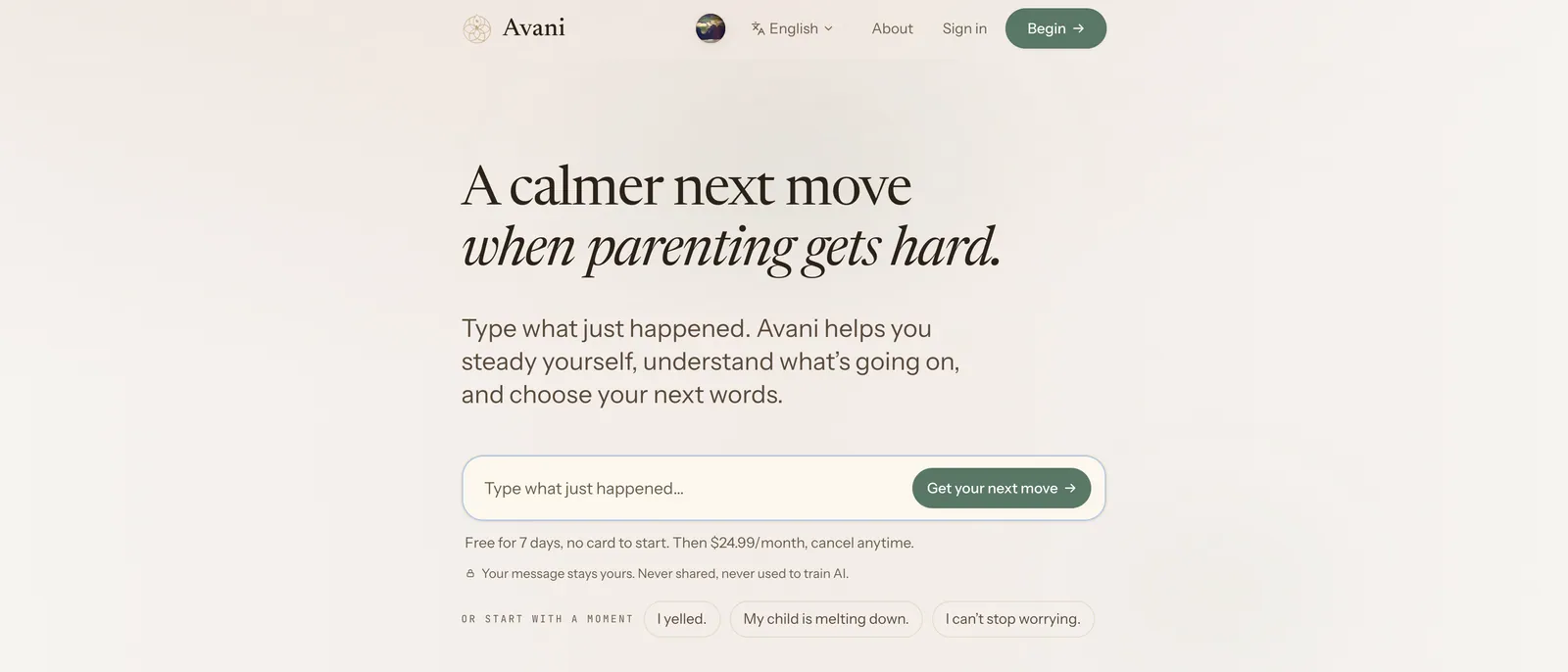
A coaching AI that knows when to stop coaching
A parent reaches for help at 2am, not when a therapist is free. The coach has to read the emotional tone, remember the relationship from last time, and know when it is out of its depth.
Domain
Coaching & relational support
Type
Conversational product
Focus
Trust, memory, tone
In one line
Avani coaches parents through charged moments, then hands off to a human when the moment calls for one, in a private space the user controls.
The control point it built · The trust layer
Tone, memory, and boundaries, the surface a coaching product gets judged on, scored against a bar you can show the buyer who carries the risk.
What it demonstrates
The system we built
Avani remembers the people and patterns a user is working through, matches its tone to how charged the moment is, and decides when to reflect, when to ask a question, and when to back off. The conversation design draws on coaching and therapy practice.
The reason AI was useful
A human coach cannot be there at 2am. Avani names the feeling, slows the reaction, and recalls what was said last week, the moves that make relational support work, the moment a parent opens it.
The parts that made it trust-sensitive
The content is intimate, the user is often upset, and the memory that makes Avani useful also makes it risky. We defined what it remembers, how the user sees and edits it, where it declines to act as a clinician, and when it tells a parent to call one.
The outcome
Avani holds memory the user can see and edit, matches its tone to the moment, and tells a parent to call a pediatrician instead of playing clinician.
Product decisions
The calls that shaped how it behaves
Tone before features
We specified Avani's tone, pacing, and restraint in a charged moment before we built a single feature.
Memory the user can see
The memory that makes Avani useful over time is legible and editable. The user can read what it remembers and change it.
Clear boundaries
Refusal and escalation behavior keep Avani in its lane. It says so and points to human help when a moment calls for a clinician.
Private by default
Avani is built for one person and the relationships they are working through. Privacy is on by default, so the user does not have to search settings to enable it.
Architecture
The layers that hold it together
Conversational layer
A frontend and prompt architecture tuned for emotional pacing, reflection, and therapy-informed support.
Memory model
A memory model that tracks people, patterns, and history, and stays readable and editable by the user.
Trust and safety layer
Refusal behavior, escalation cues, and limits on advice, expressed in the conversation rather than buried in a policy doc.
Evaluation
Golden eval sets that score tone, steadiness, and whether the response fits the moment, run on every model change.
Current status
Avani is an active Hunter Green product, in development as a parenting and relationship coach.
What this proves about Hunter Green
Avani took the responses that carry the most risk for a coaching product, the charged and intimate ones, and made the coach's behavior in them measurable. We designed tone, privacy, memory, and escalation first and scored them against a bar you can show a buyer.