
SupplierKit · Travel operations · decision-support AI
An ops AI a coordinator can put in the workflow
Supplier insurance and verifications live in inboxes, shared drives, and one coordinator's memory. Chasing renewals is manual and easy to drop, and an expired document usually surfaces the day a trip depends on it.
Domain
Travel operations
Type
Operational system + managed service
Focus
Readiness, verification, continuity
In one line
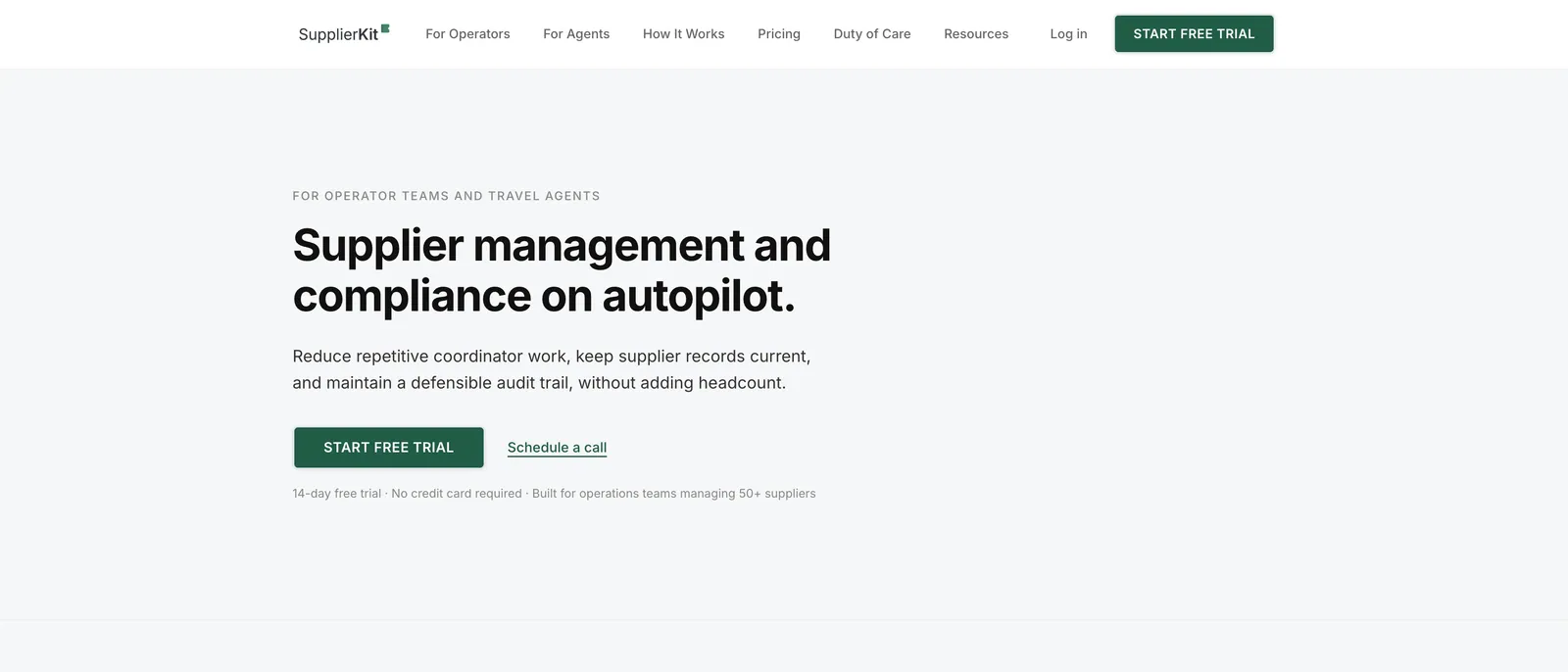
SupplierKit pulls supplier documents out of inboxes and one coordinator's memory into an auditable record, with a person on every verification.
The control point it built · The system of record
The auditable record that sits upstream of every verification, signed off by a person and fitted to the tools a team already runs.
What it demonstrates
The system we built
SupplierKit runs on a loop coordinators already know (chase, review, monitor). It collects supplier documents, routes them through human review, then tracks renewal dates so nothing expires unnoticed. A managed service runs alongside the software, so the team does less of the chasing itself.
The reason AI was useful
AI reads and classifies the documents, drafts the chase email, flags what is missing or expiring, and summarizes where a supplier stands. People keep the verification call and the exceptions, where the accountability sits.
The parts that made it trust-sensitive
This work is compliance-adjacent, so the bar is high. Every document, decision, and status change is traceable, a person signs off on each verification, and SupplierKit sits alongside the tools a team already runs. Trust comes from an auditable record, not from automation people cannot check.
The outcome
Documents move through human review, SupplierKit tracks renewal dates, and the team learns what is expiring before a trip depends on it.
Product decisions
The calls that shaped how it behaves
Chase, review, monitor
SupplierKit follows a loop coordinators already run by hand, so it reads as relief on day one rather than a new tool to learn.
A person on every verification
Software handles collection and chasing. A coordinator makes the verification call, because that is where the accountability sits.
One auditable record
Status, history, and documents live in one record, so a renewal date no longer hides in an inbox or one person's head.
Fits the existing stack
SupplierKit wraps and coordinates the tools a team already runs on, instead of asking them to move.
Architecture
The layers that hold it together
Documentation pipeline
Intake, extraction, and classification of supplier documents, with the repetitive chasing automated.
Review workflow
A review layer where coordinators verify, approve, and resolve the exceptions the software flags.
Monitoring and status
Renewal tracking that surfaces what is expiring or missing before a trip depends on it.
Managed service layer
A service team that runs alongside the software so the coordinators chase less themselves.
Current status
SupplierKit is an active Hunter Green system, built for travel teams managing supplier documents, verification, and renewals.
What this proves about Hunter Green
SupplierKit put an operational agent inside a live workflow without losing the audit trail. A person signs off where it counts, it fits the systems a team already runs, and the supplier knowledge that lived in inboxes and one coordinator's head now lives in one record.
More work